
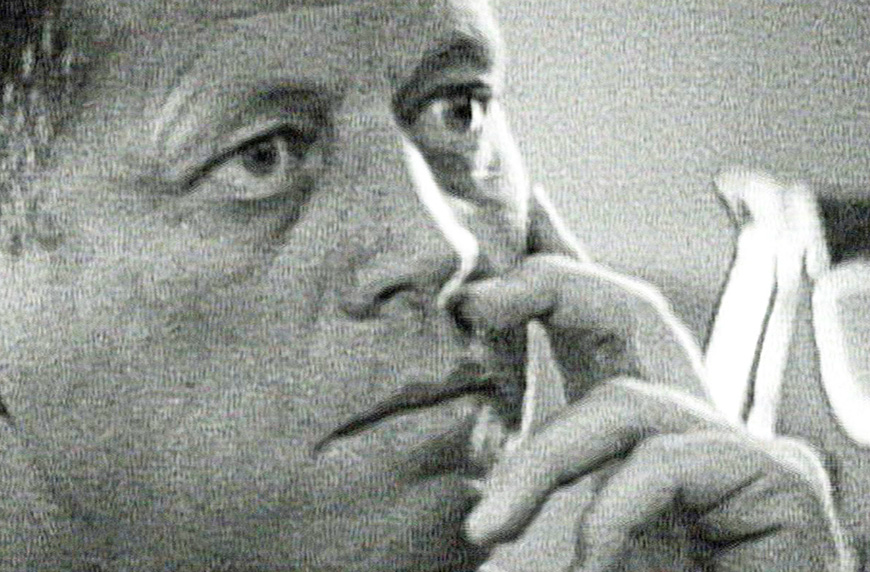
This film views President John F. Kennedy through the groundbreaking candid filmmaking of Robert Drew -- four phases of Kennedy’s life as seen in footage from four Drew films.
PRIMARY: John F. Kennedy campaigning for the Presidency.
ADVENTURES ON THE NEW FRONTIER: an ebullient young President moves into the
White House.
CRISIS: BEHIND A PRESIDENTIAL COMMITMENT: a burdened President in a
showdown with the Governor of Alabama, (George Wallace) over the integration
of the University of Alabama.
FACES OF NOVEMBER: the assassination of President John F. Kennedy as seen through the
faces of his compatriots.
Edited together with other footage from the time, these films render a candid history
of John F. Kennedy’s political life.
I. THE CAMERA AND THE CANDIDATE
Just as John F. Kennedy was beginning to campaign for the Presidency, a special motion picture camera was being readied by Robert Drew and his associates. It was small enough to be able to move with people. The idea behind it: to be able to photograph life as it happens without direction or interference, as the basis for a new kind of candid film journalism.
Looking for the first story to tell with his new camera, Drew became fascinated with John F. Kennedy and the challenges he faced running for the Presidency. Veteran politicians considered Kennedy at 42 too young, too Catholic, too inexperienced – and he was opposed by his own party and its elders, including former President Harry Truman.
“A new form of reporting, a new form of history,” Drew promised Kennedy, if the candidate would agree to allow the new camera to live with him for five days and nights while he campaigned.
Kennedy agreed.
The film was “PRIMARY,” a close and intimate look at Senator John F. Kennedy as he campaigns for the Presidency against Hubert Humphrey in the Wisconsin primary. With no interviews and little narration, it would allow audiences to see for themselves what it would be like to travel in the company of John. F. Kennedy. A candid first in politics, it was also a candid first in filmmaking. It became the first of four historic Drew films on John F. Kennedy.
Unlike the directed documentaries of the day, PRIMARY’s freewheeling photography moved with its subjects and brought audiences straight into the action. It captured Kennedy’s rock -star-like presence and Jackie’s quiet radiance. It granted audiences unprecedented access into the world of a young politician and his glamorous wife as they campaigned across the Wisconsin landscape and navigated their way through throngs of ardent supporters. And while it is no mystery who ultimately made it to the White House, “PRIMARY” builds with dramatic tension as the candidates await the returns, capturing the character and flavor of campaign politics as never before seen on film.
With this new, long running, candid footage, Drew was able to outline the editing for a story that would tell itself through the dramatic logic of people living through an event, with less than three minutes of narration.
PRIMARY received the Robert Flaherty Award and the American Film Festival Blue Ribbon in 1960 and was recognized as a breakthrough in documentary filmmaking around the world. Dubbed “cinema verite” in Europe, Drew’s form was quickly copied in documentary and feature films. In 1990, PRIMARY was selected as an historic American film for inclusion in the Library of Congress’ National Film Registry.
II. A PRESIDENTIAL TEST
Before Kennedy’s inauguration, Robert Drew screened PRIMARY for him in West Palm Beach. “At that time I was proposing that we make a new kind of history of the Presidency,” recalls Drew, “that we would see and feel all the things that bore on the Presidency at a given time – the expressions on faces, the mood of the country, the tensions in the room – so that future Presidents could look back at this and see and learn. And I thought Kennedy, who had written a history book, might agree that history should be recorded in a different way.”
Kennedy saw the historical significance of this new kind of filmmaking, and when Drew proposed to make a film on JFK, as President dealing with a crisis, Kennedy said, “Yes – what if I could see what went on in the White House during the 24 hours before FDR declared war on Japan?”
Kennedy asked Drew to do some tests first to see if he would forget the cameras in the White House as he had during the Wisconsin campaign. Eight weeks later, Drew
went into the Oval Office with a two-man team and recorded for two days. He captured on film a young President wrapped up in work on poverty in West Virginia, the Cold War
in Africa and military maneuvers off Cuba. Kennedy had forgotten the camera so completely, that when, in a meeting with the Joint Chiefs, the subject turned toward Cuba, (the invasion of Cuba had not yet taken place) an admiral had to remind the President that the camera was still there.
These tests were the first films ever to show a President doing real work in the White House. They became part of a Drew special for ABC, ADVENTURES ON THE NEW FRONTIER, and succeeded with its sequence with the Joint Chiefs intact in clearing the way for CRISIS: BEHIND A PRESIDENTIAL COMMITMENT, Drew’s third major film on JFK.
III. CRISIS: BEHIND A PRESIDENTIAL COMMITMENT
CRISIS documented the showdown between Alabama Governor George Wallace and President Kennedy over the integration of the University of Alabama.
Wallace vowed to stand in the school house door to prevent the integration of two African-American students, Vivian Malone and James Hood; Attorney General Robert Kennedy and the President were committed to upholding a federal court order that demanded the admission of the students.
In the Oval Office, the President and Robert Kennedy hammered out strategy they hoped would gain admission for the two students without having to jail the governor: in a first try to register the students, they would allow the governor to turn them back; in the second try, the President would take over the Alabama National Guard. Meanwhile, five Drew teams ranged from the Oval Office to the Justice Department to the University of Alabama, capturing the human details of a drama deeply affecting the country, the civil rights movement and the Presidency.
In CRISIS, we see Deputy Attorney General Nicholas Katzenbach confronting the governor twice. The first time, Katzenbach turned back in the face of the governor’s defiance; the second time, confronted by his own National Guard, the governor backed down, and the students were admitted. That night, in a nationally-televised speech, President Kennedy became the first President since Abraham Lincoln to commit the power of the Presidency behind civil rights as a moral issue.
CRISIS was described by reviewer John Horn as “an unprecedented television documentary…a milestone in film journalism.”
IV. FACES OF NOVEMBER
Robert Drew’s fourth film on President Kennedy, “Faces of November” is a view of reactions to President Kennedy’s funeral as reflected in the faces of participants and onlookers on November 24-25, 1963. FACES OF NOVEMBER was the first film to win two first prizes at the Venice Film Festival, one each in the theatrical and television categories.
The four Drew films on JFK, edited into “A President to Remember: In the Company of John F. Kennedy” are a history of his years from young Senator to President to fallen icon and the beginning of the history of Cinema Verite in America.